

RTLS asset tracking combines real-time location systems (RTLS) with traditional asset tracking to provide greater visibility into where assets are and how they move. This approach enables teams to monitor movement continuously rather than relying only on periodic scans.
Although the terms RTLS and asset tracking are often used interchangeably, they rely on different technologies and capture location data in different ways. In use, the key difference between RTLS and asset tracking is continuous visibility versus checkpoint-based visibility. Understanding these differences will help your team determine whether RTLS asset tracking is the right solution.
In the following sections, we’ll break down RTLS and Asset Tracking separately and then show how when combined, RTLS Asset Tracking provides continuous visibility for asset management.
What is RTLS (Real-Time Location Systems)?
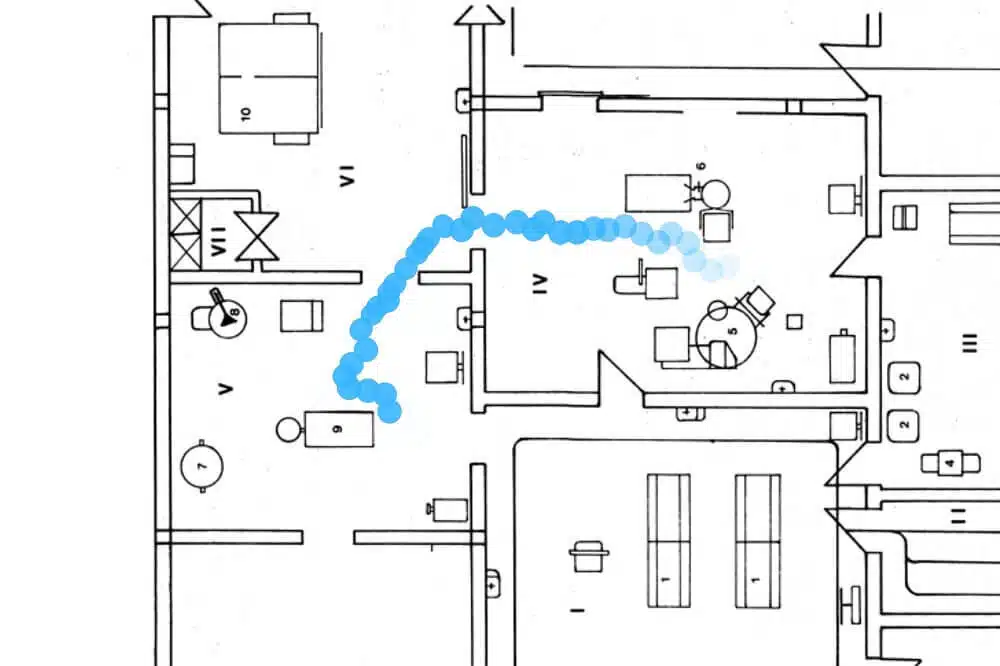
The term RTLS describes systems used to generate in-the-moment updates on the location of specific objects. Often referred to as the blue dot on the map, RTLS shows where something is at every given moment. It’s similar to having a video of the full pathway of every asset.
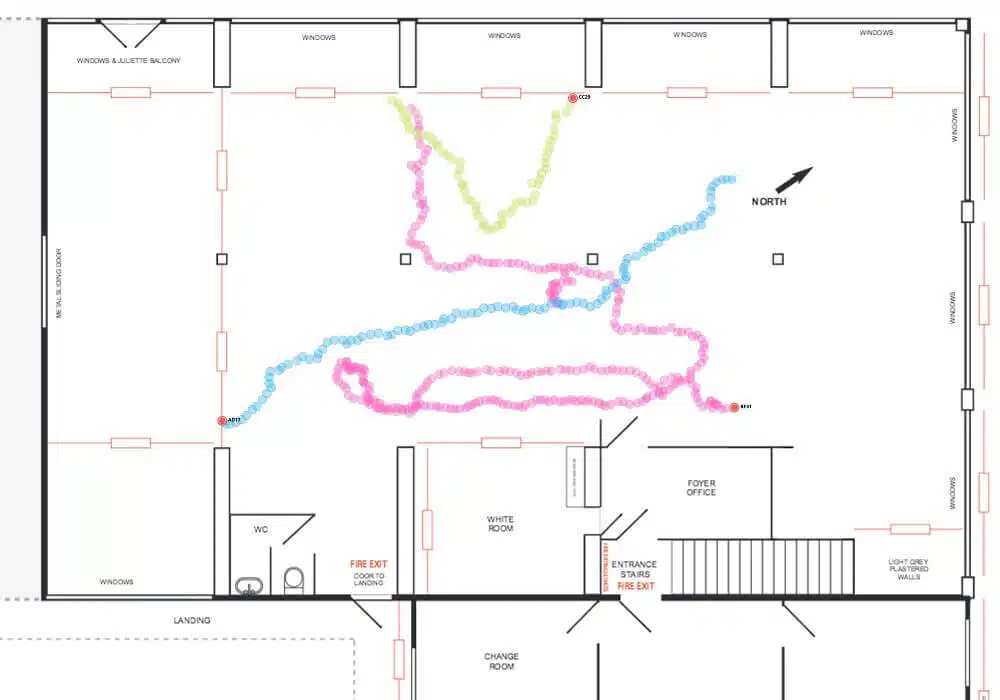
This helps teams find items that can easily get moved around, like calibrated gauges or re-worked electrical harnesses. A shop with a good RTLS asset tracking system can track work-in-progress across a facility and even catch bottlenecks as they evolve in real-time. This level of visibility gives actionable insights that can dramatically improve efficiency. In addition by storing and analyzing the historical data, these systems can create heat maps, spaghetti diagrams, waterfall charts, and other analytical tools that highlight potential areas for process improvement for stronger ROIs.
How RTLS Tracking Works?
RTLS provides a continuous stream of location data over time. This is what enables a “video-like” view of operations, rather than the “snapshots” provided by traditional asset tracking. Generally, RTLS systems involve setting up a grid of antennas or anchor points across a trackable area. Any tagged items within that area can be tracked in real time. Stored data often includes a time stamp, an identifier, as well as an x, y, and sometimes z coordinates.
Common RTLS Technologies (UWB, BLE, Wi-Fi)
RTLS Asset Tracking solutions rely on several wireless technologies, each with different tradeoffs in accuracy, cost, and scalability. Ultra-wideband (UWB) provides the highest precision (often sub-meter) making it ideal for tracking assets and workflows in dynamic environments like manufacturing.
Bluetooth Low Energy (BLE) offers a lower-cost alternative with room-level accuracy and easier deployment. Wi-Fi–based RTLS leverages existing network infrastructure, providing broad coverage with moderate accuracy.
While these technologies vary in performance and cost, they all enable continuous, automatic location updates, which is the defining characteristic of RTLS. Still, some are more ideal for specific use cases or environments. For a deeper comparison of RTLS technologies like UWB, BLE, and Wi-Fi, see our guide: Everything You Need to Know About RTLS.
Common Uses of RTLS
The primary use of RTLS systems is to find the stuff that gets lost all the time. For busy, and especially non-linear manufacturing shops, this can be a game changer. For example, a good RTLS system enables workers to find that calibrated gauge in seconds rather than hunting around through work stations for several minutes. When a customer calls, they can identify exactly where the final WIP parts are and know whether the deadline will be met.
RTLS systems that offer zone or geo-fence-based alerts can notify in real-time if an item is in the wrong place or has been lagging in a workstation too long. All of these uses offer meaningful returns on an RTLS solution.
The secondary major use is analyzing the collected historical data. As an example, one WISER customer generated heatmaps showing where key items or personnel moved in their factory. Their goal was to use location data to optimize and streamline location-based processes, such as moving unfinished product from point A to point B, or employees moving between workstations without adding menial labor such as frequent location scans. WISER’s ultra-wideband (UWB) RTLS offered the ideal tool to accomplish this.
What is Asset Tracking?
The term asset tracking describes a system to monitor or update the status of various assets, especially physical ones. At some point in the asset’s journey, its location and identifier are recorded. This is not necessarily specific to where an asset actually is later on. It could have been moved. Rather, asset tracking helps the user know it entered the correct spot, say a loading dock, or inventory room.
Asset tracking really shines when you only need visibility at key checkpoints, say in receiving or storage. It is generally sufficient when assets move through defined workflows such as conveyor belt manufacturing. The low tag cost makes asset tracking attractive for certain industries. For example in clothing retail, tagging every asset with a real-time tag can be cost-prohibitive. However, tagging a tote or basket that travels with a shopper can provide very valuable information about which displays attract shoppers or which products are most desirable.
How Asset Tracking Works?
In practice, asset tracking could take the shape of the blue dot on the map referenced above, but often simply describe a list of tracked assets and their last-known status.
Below is sample data from an asset tracking solution
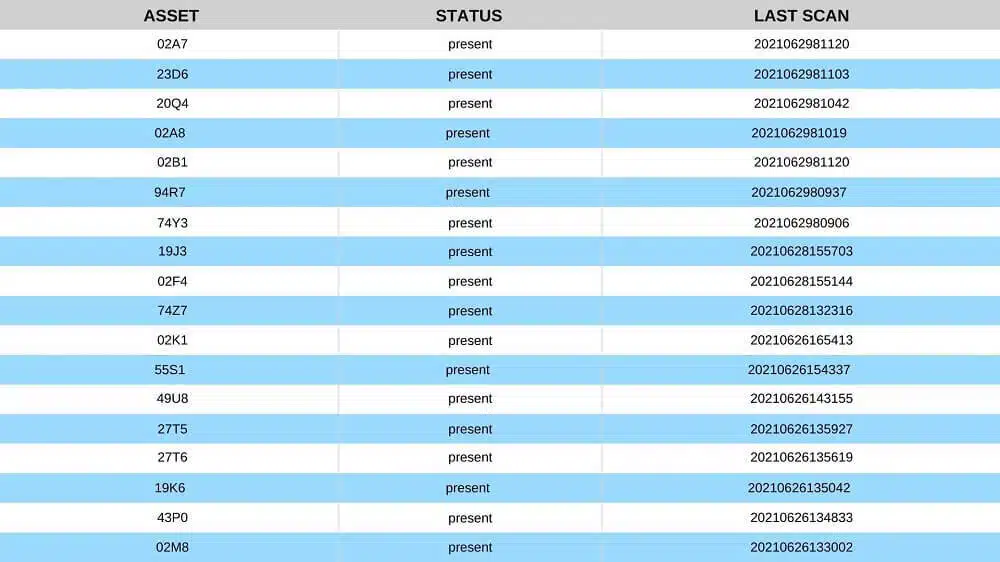
Whereas RTLS identifies what, when, and where, asset tracking is primarily concerned with identification (what) and incorporates other types of data (where, when, who, etc.) less uniformly. Location, whether real-time or defined by at-rest / static endpoints, is an especially common component of asset tracking as well. Notably, location data doesn’t always need to be continuous for an effective asset tracking system.
Asset Tracking Technologies (Barcode, RFID, GPS)
Asset tracking solutions have been used for decades, with technologies that vary in cost, automation, and accuracy. The most basic approach is barcode scanning, where a worker manually scans an item to update its status in a database. This provides simple, low-cost tracking at specific checkpoints.
RFID builds on this by enabling wireless identification without line-of-sight. Passive RFID systems can read multiple tags at short range, often through portal readers or handheld devices. Active RFID systems, in turn, can provide longer read ranges and more automated data capture. This makes RFID well-suited for environments like warehouses and manufacturing facilities.
GPS is commonly used for asset tracking in logistics and transportation. It provides location data over large geographic areas and can support real-time tracking. However, it is primarily effective outdoors and typically offers lower precision compared to indoor RTLS technologies. For this reason, GPS is often used alongside other asset tracking methods rather than as a standalone solution in facility-level operations.
Example: Package Tracking System
A common example of asset tracking is global package tracking. Packages are assigned a barcode when the carrier first receives them, and the barcode is scanned at key points along the journey. This allows customers to track progress from origin to delivery, but only at those specific checkpoints. In other words, the system shows where a package was last scanned, but not its exact current location.
In some cases, GPS is used to track higher-level assets like trucks, containers, or pallets, providing more continuous visibility. Amazon has taken this a step further, by sharing GPS-based vehicle tracking during the final stage of delivery, giving customers a near real-time view of their package as it approaches.
Types of Asset Tracking
Another caveat to asset tracking: Most end users will draw distinctions between asset tracking (a very broad term) and specific applications of asset tracking technology. For example, fleet management, yard management, or forklift tracking could all be called simply asset tracking, but clearly these terms offer more clarity. Often workers in the field might never call these processes ‘asset tracking’ even when utilizing asset tracking systems every single day
When to Use RTLS vs Asset Tracking
Now that we have a clearer understanding of the differences between the two, it’s important to understand when each is the better solution.
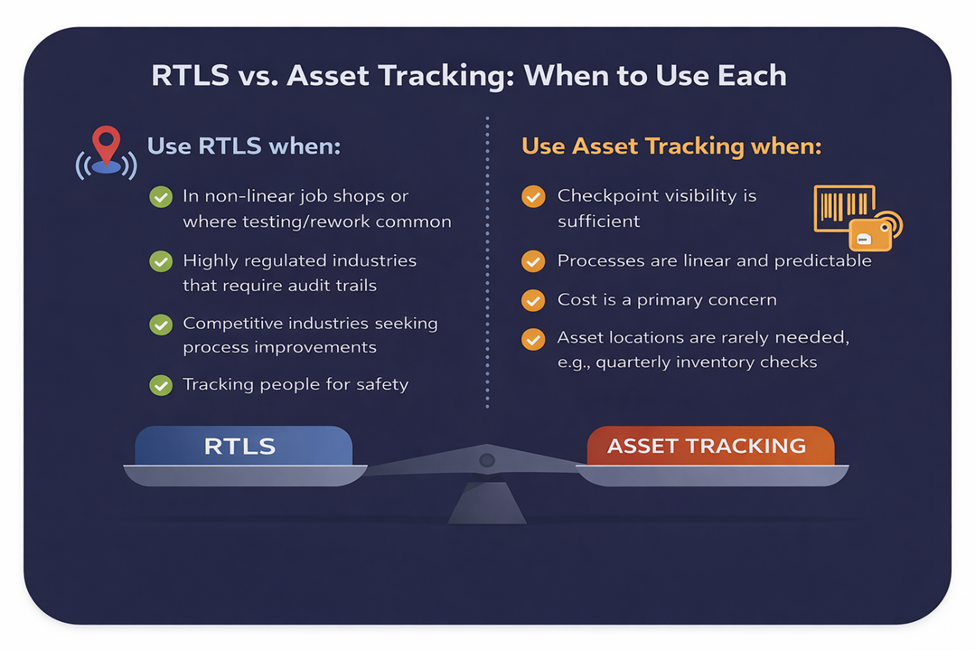
RTLS Asset Tracking provides a “video-like” view of operations, making it easier to understand how work flows through a facility and where delays occur.
Use RTLS Asset Tracking when:
- You need continuous visibility into asset movement over time
- You operate in non-linear job shops where work-in-process can be difficult to track
- Testing and rework are common, and items can easily get misplaced
- You work in highly regulated industries (e.g., aerospace, automotive, biomedical) that require traceability
- You’re in a competitive environment where improving efficiency and identifying bottlenecks is critical
Asset Tracking without RTLS provides “snap shots” of critical points in an assets journey. For example when materials arrive at the warehouse or on inventory dates.
Use Non-RTLS Asset Tracking when:
- Checkpoint visibility is sufficient (e.g., receiving, storage, shipping)
- Processes are linear and predictable, following defined steps
- Assets are lower cost, and continuous tracking isn’t justified
- You only need periodic visibility, such as during inventory checks
When to use RTLS and Asset Tracking Together
And of course, there are many times when a combined solution really is best. A classic combination is barcode tagging lower cost items and assigning them to a tote or cart that is tracked via RTLS. This is great for construction material manufacturing like glass and roofing materials. Any area where groups of products easily travel together through manufacturing is a good fit. Another area is tool crib management where toolboxes might be tracked via RTLS, but the individual tools are checked in and out using a barcode scanner. To ensure compliance, if a toolbox is opened, an alert-enabled RTLS system can record a timestamp of that event. That makes tracking down a mislaid tool easier. For more details on using UWB and RFID together, please feel free to check out this related article.
Conclusion
The difference between RTLS and asset tracking ultimately comes down to visibility. If you need a continuous, real-time understanding of how assets move through your operation, RTLS Asset Tracking provides the “video” needed to identify bottlenecks, improve workflows, and drive efficiency. If you only need to know where assets are at specific points in time, asset tracking offers a simpler and more cost-effective solution.
In many operations, the right answer isn’t one or the other. Instead, it’s a combination of both. Using asset tracking for lower-cost items and RTLS for high-value assets or containers can deliver the visibility you need without unnecessary complexity.
The key is to start with your objective: what decisions are you trying to make, and what level of visibility do you need to make them? Answering that question will make it clear which approach is the best fit for your operation.
Frequently Asked Questions (FAQ)
The main difference is how location data is captured. RTLS provides continuous, real-time visibility into where assets are as they move, while asset tracking records location at specific points in time, such as when an item is scanned. In simple terms, RTLS is like a video of asset movement, while asset tracking is a series of snapshots.
RFID is typically used for asset tracking rather than RTLS. Most RFID systems rely on scanning tags at specific checkpoints, which provide event-based location updates rather than continuous tracking. However, some active RFID systems can support RTLS-like capabilities, depending on how they are implemented.
GPS can be considered a type of RTLS, but it is primarily used for outdoor tracking. While GPS provides real-time location data, it generally lacks the accuracy and reliability needed for indoor environments, where most RTLS solutions use technologies like UWB, BLE, or Wi-Fi instead.
RTLS is generally more accurate because it continuously tracks asset location and can pinpoint position with high precision, especially with technologies like UWB. Asset tracking, on the other hand, only reflects where an asset was last scanned, not where it is at any given moment.
No, you don’t need RTLS for asset tracking. Many asset tracking systems rely on barcodes or RFID to track items at specific checkpoints. However, RTLS can enhance asset tracking by adding continuous, real-time visibility, which is useful for optimizing workflows and tracking movement within a facility
Post originally by Stephen Taylor