
F.A.Q.
Frequently Asked Questions
General
What makes WISER's tracking and location system different from other tracking systems?
WISER’s system is unique especially in metal, crowded, reflective environments because it uses UWB technology paired with proprietary algorithms and software that better estimate location in these tough environments. We’ve also designed the interface with industrial users in mind with features like: zone alerts, tag assignment window, simple search and find, easy API integration, and access to historical data.
Visit our Product Page for more information about WISER’s solution.
How do people use the WISER system?
Customers primarily use the WISER system to streamline operations, save time, and cut costs related to misplaced assets or personnel. Our versatile solution is integral to diverse applications such as process optimization, work in progress tracking, tool tracking, yard management, and cart tracking. Check out the real-world impact of WISER’s Solution through our latest Case Studies. Elevate efficiency, reduce expenses, and enhance safety with WISER’s innovative technology.
How accurate is WISER’s asset tracking systems?
In most environments, WISER tracks at sub-meter accuracy and in some cases down to 6 inches. WISER’s asset tracking Real-Time Location System (RTLS) is engineered to tackle the unique challenges posed by industrial environments, such as heavy clutter, reflective metal, wireless interference, and moving obstacles.
What certifications do you have?
WISER’s solutions are FCC, CE and IC (Industry Canada) certified.
WISER Infrastructure
What kinds of assets can WISER's system track?
Our micro-location system excels at locating and tracking almost any type of material asset, ranging from work orders, parts, and subassemblies to crates, pallets, bins, forklifts, individual tools, robots, electronic devices, and more.
Once our antenna mesh is in place, simply attach a WISER Tracker Tag to the asset you wish to locate. For real-world examples of the system in action, check out WISER’s current Use Cases and Blog to witness the seamless tracking of diverse assets.
How many assets can I track with WISER?
WISER can track anywhere from 1 asset to 10’s of thousands. As the system is scalable in both the trackable area and the number of tags tracked, you can start small and organically grow your mesh and tag # as demand increases.
See our case study where we are tracking 3,600 parts continuously.
What infrastructure do I need to install WISER's system?
WISER tracking arenas can be installed quickly with minimal infrastructure. WISER’s system tracks and locates without reliance on WiFi, Cellular, or other wireless networks. Tracking antennas can be powered via wall outlets, USB batteries, or Power over Ethernet (PoE). Large-scale installations typically use Ethernet to connect antennas.
Can you locate assets through partitions and walls?
WISER’s system allows non-line-of-sight locating and tracking through most interior walls and partitions. Tracking range depends on what the walls are made of, their thickness, and other environmental factors.
Can you track outdoors?
Yes. WISER can deploy outdoor tracking solutions using weather-resistant antennas and infrastructure designed to operate in harsh environmental conditions. These systems can be powered through wired connections, batteries, or solar power to accommodate different site requirements and power limitations. Outdoor WISER meshes can function independently or integrate seamlessly with existing indoor WISER networks.
How large are your tracking devices?
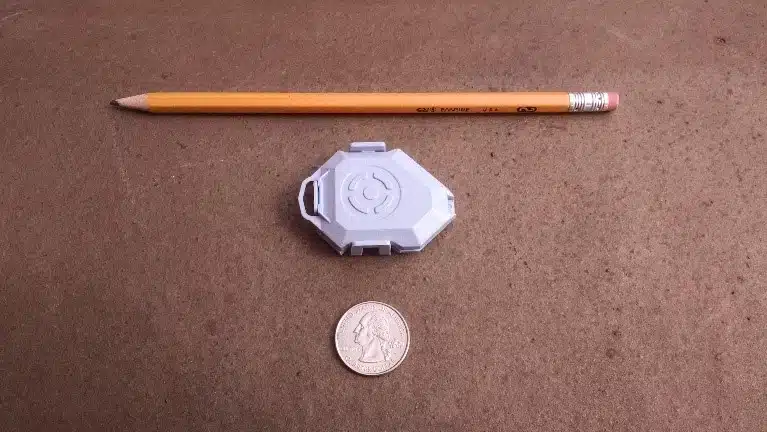
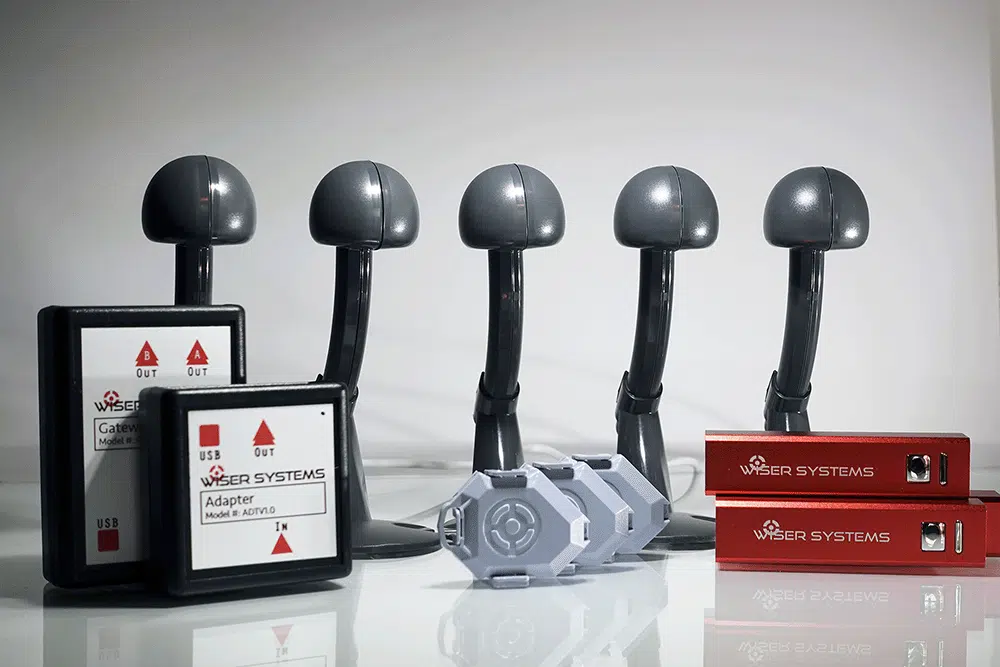
All of WISER’s devices are small and lightweight. Antenna nodes are approximately 6″ x 2″ x 1″ and tracker tags are 1″ x 1.5″ in size. A system to cover 40,000 square feet can easily fit in a backpack, weighing only a few pounds.
How long will batteries last?
WISER tags are designed to last for three to five years with normal usage. In addition, our tags are equipped with off-the-shelf coin cell batteries that can be changed by the user. The longevity of the batteries is influenced by the tag’s ping rates and movement frequency.
If I use barcoding or RFID tags at my facility, can I continue to use them with WISER’s system?
Yes. The WISER system does not interfere with passive RFID or barcodes and can be used in conjunction with these systems. In fact many of our customers use both.
For more information about using a WISER RTLS solution alongside RFID, read our post UWB RFID Integration Solutions.
How many antenna nodes do I need for my facility?
In most indoor manufacturing facilities, 4 antennas can cover 2,500 – 10,000 square feet. The spacing of antennas depends on the building construction and materials, clutter, and RF reflections. The size, shape, materials, and complexity of your site will also influence this number.
IT Questions
Can the WISER system be hosted on-prem or in the cloud?
We do both. WISER offers many hosting solutions depending on the use case and the needs of the customer. We offer the below installations:
- Isolated POC Setup: A standalone laptop and wireless system—quick to deploy and ideal for early demonstrations.
- On-Prem with PoE + Isolated VLAN: WISER is hosted completely on customer network and within their firewall, giving customer IT complete control and management of the WISER system and produced data.
- Cloud-Hosted Solutions: On-site WISER hardware communicates with AWS-hosted WISER cloud. This reduces IT overhead but customer still owns all their data. Options include:
- Edge-device data routing (IT manages only the connection)
- “No-touch” cloud setup using separate internet or cellular
- Hybrid on-prem with cellular access for occasional remote management.
What kinds of data does this system gather?
At the basic level the WISER System generates location data in x, y, and sometimes z coordinates, timestamp for each location point, and battery levels for individual tags.
The software also allows users to establish zones, groups, alternate IDs and other reportable information. WISER provides tools to process and visualize the data as well to include spaghetti diagrams, heat maps, and waterfall charts.
How can I access WISER data?
To access WISER’s location data, you can use the WISER app which can be downloaded to any Android, Apple, or Microsoft device. You can also integrate it into your ERP/MES via our REST API as well as Server Sent Events. Finally you can download all WISER’s historical data to a database for later analysis.
Will my data be secure? What information is stored and transmitted by the WISER tags?
Yes. WISER’s system offers strong security. The tags transmit only the ID and timestamp of the tag to the antennas and from there to the system server. There are no additional identifying features such as names or groups until you get inside the server software. Therefore, the same protocols you use to keep your data secure within your IT environment will apply to the WISER solution.
Does the WISER System require WiFi or existing wireless networks?
No. WISER does not require WiFi or other existing wireless networks. Operating independently from company WiFi or cloud services adds security and reduces exposure to hacking or malicious access.
Asset Tracking and RTLS
What is asset tracking in manufacturing?
Asset tracking—as opposed to digital asset management—accounts for physical objects of almost any variety. Asset tracking systems frequently account for work-in-progress or work order tracking in a manufacturing facility, goods in inventory, vehicles, shipping containers, calibrated tools, electronics, medical equipment, pharmaceutical products, retail goods, and dozens of other asset categories.
Some asset tracking systems will be better suited for one type of asset over another. For instance, passive RFID tags can be extremely small, making them optimal for tracking a variety of smaller objects. However, passive RFID tags are not always reliable for tracking metal objects or items with high water content. In these cases, barcodes might be a better option. Neither barcodes nor passive RFID gives real-time tracking, so high-value assets that move frequently or in unpredictable ways might be more effectively tracked with a real-time location system (RTLS).
See our Technology Comparison for more information on different asset tracking technologies.
How do I determine the right kind of asset tracking system for my business?
A few key questions can guide you to select the right kind of asset tracking solution for you and your organization:
How many assets do I need to track?
How valuable are each of those assets?
What will it cost me—or what risks will I face—if I do lose any of those assets?
How much does my current inventory or accountability process cost me in time and money?
How much do I stand to gain or save by adopting a new system?
What other problems am I looking to solve via asset tracking?
For more information on Asset Tracking look at our guide:
What industries use asset tracking?
You can find instances of asset tracking across nearly every industry today. Some industries use their own terminology to describe their tracking systems, but you can find clear examples of asset tracking at work across retail, shipping and logistics, transit, manufacturing, warehousing, healthcare, energy, construction, and education.
How can I be sure an asset tracking system is scalable for my use case?
Scalability is a top challenge for nearly any process-improvement system, and asset tracking is no different. Assuming you’ve already vetted your asset tracking system vendor adequately, the three biggest obstacles to scalability tend to be:
- Technological Limitations
- Cost
- Labor
The best way to determine if your asset tracking project is scalable is to map out how these obstacles intersect in the case of your own asset tracking project.
What is UWB?
Ultra-Wideband (UWB) is a wireless technology that can measure exactly how long a signal takes to travel, instead of just how strong it is. This makes UWB much more accurate than Wi-Fi or Bluetooth, especially in tricky environments with lots of metal or obstacles. WISER takes UWB even further by using smart algorithms and automatic calibration, so it keeps working reliably in reflective, metal environments and even if equipment is moved or the space changes.
Learn more about the physics of UWB in our video What is the UWB Difference? It’s in the Physics.
Ask a Question
Still Need Help?
Reach out to ask a question and find out how we can revolutionize the way you work.
WISER has tracked many things in many places, we’d love to hear your use-case and see how we can help.